Posts

the ugly side of patriotism
Image
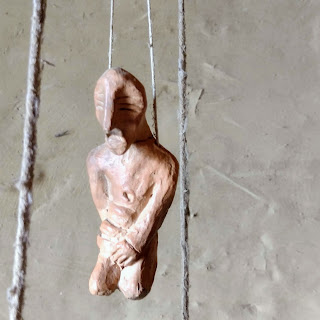
Photo taken at the archeological site in Dispilio, Greece - a mysterious Neolithic idol (figurine) at least 5,000 years old. This foreboding poem by Ribeiro Couto (1898-1963) speaks of all too popular ideas in this world where the hoi polloi are easily manipulated by the powerful.   The hero who killed the little enemy king by Ribeiro Couto Wounded, I return from war. The people, they tell me, "Soldier, You're so brave and so much more!" The average guy is a joker! Wounded, I return from war. "Let there be glory to scars! Yours, in the most remote nation! Your blessed name shines like stars."  Oh, most unhappy prostration!  Wounded, I return from war. The fiercest battle I’ve won,  and been awarded this medal,  most desired under the sun. My God, no matter how special, I return from war outdone. As a punishment, by luck, I see the enemy king  Dying in these bloodied hands,  Crying with me, agonizing… Coming back - by this war struck.

miracles

Image
(Photo from the movie Spirited Away) This translation is an excerpt from one of Manuel Bandeira's poems. Life is a miracle. Each flower, With its shape, its color, its scent, Each flower is a miracle. Each bird, With its plumage, in its flight, chirping, Each bird is a miracle. Space, so boundless, Space is a miracle. Time, unfathomable, Time is a miracle. Memory is a miracle. Self-awareness is a miracle. Everything is a miracle. Everything but death.

Shakespeare on grief

Image
  My own translation - into Portuguese - of this beautiful gem of Shakespeare's on grief. Luto enche o quarto de meu filho ausente,  Deita em seu leito, sobe e desce a mim,  Assume o belo porte, a fala imita,  Lembrando-me de todo o seu encanto,  Os trajes vagos veste com sua forma;  Este o motivo de gozar o luto.  Luto, adeus! foste tu sofrer a perda,  Dar-te-ia consolo bem melhor,  Tirarei esta forma da cabeça,  Pois me é tal o desvario no pensar.  Senhor! Meu filho Arthur, menino meu!  Mi'a vida, gozo, pão, meu mundo todo!  Consolo, alento, unção p'ra minha dor! Diniz Junior, E. M., & Shakespeare, W. (1998). William Shakespeare - King John Ato III, Cena IV. Cadernos De Literatura Em Tradução , (2), 20-21.

my verse is blood

Image
  Disenchantment Manuel Bandeira I write these verses as I weep, With disenchantment and dismay. Please close my book if now in glee You have no reason to cry, I pray. My verse is blood. It's burning lust... It's scattered grief and vain remorse. It hurts my veins; it makes me flush. It oozes, drop by drop, in sores. These lines, this anguish, this hoarse cry They flow like life from my dry lips, They leave an acrid aftertaste. I write these verses at death's door.

epiphany

Image
  Another Romantic poet from Brazil: Júlio Salusse (1872-1948). My translation. A vision Júlio Salusse On a steed and speedily, leaving a trail of dust, there goes a Giant, impassive, indifferent to life or death! In his arms I see, asleep, a maid, fantastic, sublime! Fair hair of golden illusion. Pale face, shattered illusions. In awe I cry to the Giant: "Who are you? Is she your lover?" And the rider - Time - replies: "I'm all and naught at once. This Lady that now you see, is your Youth in my arms, dead!"

cinnamon trees will weep for her

Image
  Cinnamon trees will weep for her Alphonsus de Guimaraens Cinnamon trees will weep for her; Their flowers will wither at the fall of the day. In orange groves fruits will fall on the ground In remembrance of the one who used to pick them.  The stars will mourn, “We’ve come to nought", As she lies there, so still and cold. Their eyes on her, their sister, grieve For her who used to smile at them. The moon, her loving mother, Who’d seen her live and love, With lilies, petals, holds her. My dreams of love are dead. In heaven archangels cry,  "Why haven’t they come together?"

an orphan sewing

Image
This is my translation of a simple and yet touching poem by Junqueira Freire (1832-1855), of Brazil's Romanticism. AN ORPHAN SEWING She taught her to raise her pure, innocent hands to heaven and seek first a glimpse of her Maker. Flechier My mother was beautiful,  She was all my joy, All that I loved.  Her hair was so fair,  Like a golden ribbon  In such splendor. Her radiant locks  Fell so long Her feet to kiss.  On hearing my complaints,  In those golden locks She enveloped me. When I was cold And my soul trembled,  And the sun was hidden,  Her long hair,  Like warm threads,  Covered me as a sheet. My mother was beautiful,  She was all my joy, All that I loved.  Her eyes were soft,  Like the chirping of birds  Above the shepherd's hut. My mother was so beautiful,  I remember her so vividly, Everything about her! Close to my chest I keep Her holy words to me, The laughter she filled me with. My faltering st...

a tired father's lament

Image
A very short except from "I-Juca Pirama," written by Gonçalves Dias (1823-1864). The last members of a Native Brazilian clan are trying to survive, a blind father and his son, who unbeknownst to him abdicates his bravery in order to care for his frail, elderly parent. VI "My son, where are you?" "Right by your side; Food and drink I bring. New your vigor be; We'll go at once!" "You took so long! The sun, unborn when you left, Now shines feeble, I sense it!" "Yes, long I wandered, Lost in the jungle maze, but found my way. Hasten! We must leave anon." "What new trials await us? Ordeals… Agonies… What else has our God in store for us? The arrows of affliction are over, On our skin not a single patch  Uncovered with bruises... You're shaking!" "Surely because I was hunting…" "Oh, my dear son!"

war, poetry & the poet's fiat

Image
No, not one of Pound's imagist poems... This is Mário Quintana in his sophisticated simplicity: WAR Planes shot down; crosses falling from the sky. What real poetry is like: ON PAGINATION Poetry books should have wide margins, several blank pages and enough blanks on each printed page so that children may fill them in with cats, men, planes, houses, chimneys, trees, moons, bridges, cars, dogs, horses, oxen, plaits and stars which will themselves become part of the poems. Life according to the poet: RHYTHM The door the housewife moves and sweeps it clean sweeps it clean sweeps it clean The basin the young girl cleans her teeth cleans her teeth cleans her teeth The brook the washerwoman beats her clothes beats her clothes beats her clothes until at last                   the world goes round                                             ...

last words

Image
A translation of one more poem by the great Mário Quintana. THE FINAL POEM All through my extreme unction I was abstracted... Ah, this hopeless obsession with thinking about something else!  Incidentally, everything is always something else - the secret of poetry. As the priest's voice came sounding like a beetle, I was thinking of my first shoes treading and treading, to this day,  the paths of this world.

from the depths of time

Image
Mário Quintana is one of Brazil's most popular poets. His poems display sophistication under the apparent simplicity of straightforward language and everyday themes. These conceal profound reflections on death, time, old age and poetry itself.  Quintana had considerable experience as a translator of Virginia Woolf, Balzac, Proust, Conrad, etc when he published his first book in 1940. A Rua dos Cataventos (The Windmill Street) was followed by many others in a versatility that includes sonnets, free verse, and even children's books. Quintana died on May 5, 1994, at the age of 87. This is my own translation of one of his precious poems: THE LOOKING GLASS Mário Quintana As I was passing by the looking glass my room could not be seen with its bookcases not even my face where time does trickle. Some portraits on the wall -  windows for severe grandfathers  and grandmas in hoop skirts,  inverted parachutes to bring them up from the depths of time. The clock said the time, ...

ineffable rooms in the house of memory

Image
  João Guimarães Rosa, Brazil's best writer ever, a genius. Virtually unknown in the English-speaking world, mainly on account of poor translations, "literal" renderings intended to please commercially-minded editors.  Want to have an inkling of what he would have sounded like in English? Read on. NONE João Guimarães Rosa Inside the farmhouse, found at random among several other resought far-off places, there came to be, in our minds, irreversible great facts—reflections, flashes of lightning and sparkles—stifled by darkness.  The mansion—strange, vanishing, behind mountains and ranges, ever, at the edge of the woods of some riverbank, which forbids imagining. Or perhaps it hasn't been on a farm, nor along the undiscovered path, nor that far? It is no longer possible to find out — nevermore. (...)  Only now sluggishly there dawns the demanding glimmer of reminiscence, at the end perhaps of an extremely long journey, striking his consciousness. (...) Plentymuch, howev...

your name

Image
This is my translation of an excerpt from the poem "Dia de São Tomé," by the talented Portuguese poet Matilde Campilho: I could write your name 70 times in a row But that wouldn't scare away this longing to utter your name through salt and teeth Or soothe the pain of your physical absence from the hollow specter sitting across from me at the restaurant every day at 11am From the passenger's seat as I drive  to the state tax agency the good old wasted state so vastly overrated Writing your name over and over from top to bottom then from left to right and diagonally like somebody hoping to win at four in a row some day... that's a poor substitute for the noise of water inside my mouth when the word You used to reverberate  between the palate and sea water against my teeth and ended up in the fissures of some rock Yes, your name between one dive and another Choking on your name and sea water and laughs Your name coming against your face at exactly the sam...

a sick mother's prayer

Image
Maria's photo in memory of my wonderful mom A sick mother's prayer Maria Cecília de M. Duprat O Lord, make me humble enough to accept that I am now being served, the one who used to wait on others so wholeheartedly at all times. Grant that I may accept the burden of being dependent - heavier than the burden of pain! Grant that I may accept the trouble I am now, the disturbance this disease causes. This sacrifice was needed that I might comprehend what you once said: "There is more joy in giving than in receiving ..." I do not want to dwell on the hustle and bustle of old. Neither do I wish to miss the manifold examples of my labors for others. Today my altar is this bed and my world, this confined room. In this succession of endless days and hours, I want my inertness to bear fruit as a seed watered by the blood of Christ. Like Abraham, let me say at every moment, "Here I am, Lord!" Let this be my response to anything you ask of me. I may not actually hear ...

the meaning of saudade

Image
Clarice Lispector (1920-1977) is an extraordinary Brazilian writer of Jewish descent. The stream of consciousness in her writings is superb and searches the depths of the soul. From her crônicas , a typically Brazilian journalistic text on any aspect of life in general: "Saudade" is a little like hunger; only when one eats the presence is one satisfied. But sometimes this longing is so intense that even their presence is not enough - one needs to absorb the other completely. This urge to be someone else in order to be one with them is one of the most demanding feelings in life. ... And I learned that Dr. Lourival, on reading my dedication, said, "Clarice gives so much to others, and yet she asks for permission to exist." Yes, Dr. Lourival, I humbly ask to exist and humbly beg for some joy, for something to be thankful for; I pray that I may be allowed to live a life with less suffering; I ask for fewer trials, fewer rough times; I ask men and women to ...

searching for words that do not exist

Image
All too often a writer's powerful poetic diction is distorted in translation in order to make it easier for the reader to understand. Like blunting a knife. An extraordinary writer like Carlos Ruiz Zafón, however, speaks also through the images his language evokes. A simplified translation that merely "tells the story" is not good enough. I now offer my own translation of an excerpt from the first chapter of his masterpiece  La sombra del viento : Shortly after the civil war, an outbreak of cholera took my mom. We buried her in Montjuic on the day I turned four. All I remember is that it rained all day and all night, and that when I asked my dad if heaven was crying, he was deeply moved and couldn't speak. Six years later, the memory of my mom was like a hallucination to me, a silence full of screams that I had not yet learned to appease with words ... I grew up among books, making invisible friends out of pages that crumbled in dust and whose smell I still have ...

away from you

Image
Florbela Espanca (1894-1930) is unmatched in the intensity of her love poems . Fernando Pessoa's much celebrated poetry seems shallow in comparison with the eloquent images of her pulsating verses. I here offer a new translation of her magnificent sonnet “Fumo.” Smoke Away from you, the paths are deserted, Away from you, no moonlight, no roses; Away from you, only silent nights, Days without heat and eaves without nests! My eyes, two poor old folks Lost throughout wintry nights... O f caressing hands dreaming, Your sweet hands of tenderness! The days are autumn: weeping... weeping... With purple chrysanthemums fading And murmurs of secrets so painful... I now invoke our dream, my hands stretched out! Oh, take it, my love, before it's all gone Like light smoke escaping through my fingers...

sonnet of contrition

Image
Vinicius de Moraes (1913-1980) is one of Brazil's most refined poets. The supreme elegance of his verses is not easy to translate. This is an attempt to render the first quatrain of his Sonnet of Contrition (1938). I love you, Maria, so much My chest, it does hurt as though sick No matter the pain they inflict Your spells all my soul fully touch.

promise

for Maria by Sophia de Mello Breyner Andresen promise you are the spring I had hoped for life multiplied and full of light each moment perfect and lived to the full

ruins

Image
Sophia de Mello Breyner Andresen (1919-2004) was an outstanding Portuguese poet. She often talked about the sea, and Ancient Greece seems omnipresent in her poetry. This post is for Maria. Despite the ruins and death, The illusions that fate smashes, All my dreams are filled with strength And my bliss rises from ashes So my hands are never empty.